
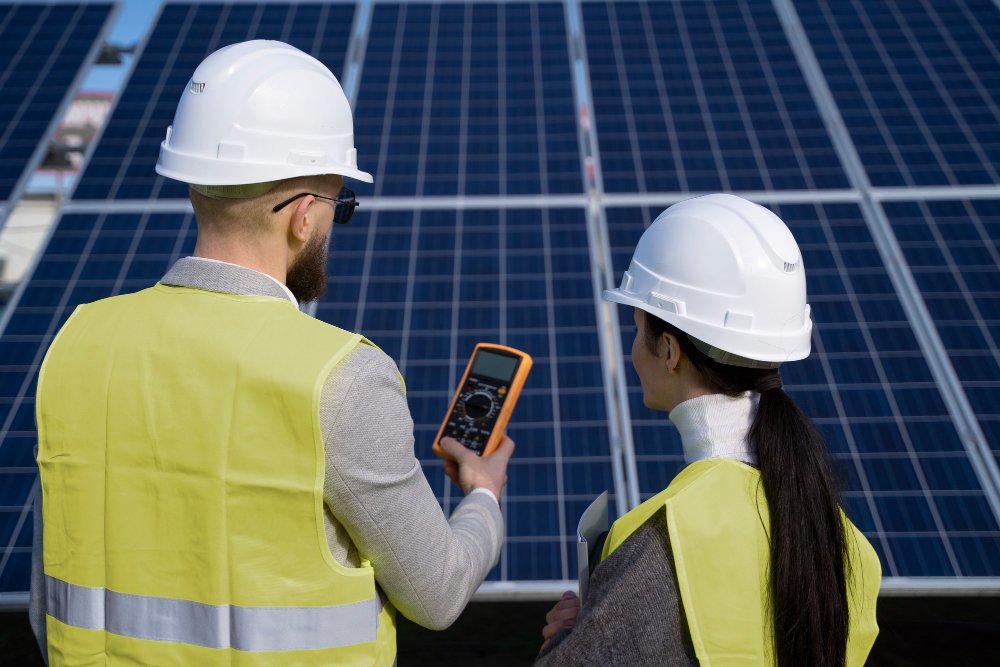
Solar Panel Testing Importance:
To put it in simpler terms, testing solar panels ensures they remain powerful, durable, and safe. These tests prove the panels work at peak efficiency, meet every promise, and run smoothly for decades.
-
1. Performance and Reliability:
Testing checks panel efficiency, power output, and electrical characteristics to ensure stable and reliable electricity generation.
2. Defect and Safety Detection:
Tests detect manufacturing defects, hotspots, and electrical risks early to maintain safe panel operation.
3. Quality and Compliance:
Testing confirms panels meet regulatory standards, support warranties, and ensure long-term durability and dependable performance.
-
The Process of Testing Solar Panels
There are two stages of testing in solar panel evaluation to ensure photovoltaic (PV) systems operate safely, efficiently, and according to their design specifications.
System Testing and Management:
This stage involves electrical safety and proper installation of the PV system. It includes resistance (continuity) testing to verify grounding, polarity testing to confirm correct component connections, and voltage and current measurements using Voc and Isc.
Insulation resistance testing detects leakage or insulation faults, while switchgear testing verifies that protective devices and control equipment operate safely.
System Performance Testing:
This stage checks the performance of the PV system using I-V curve tracing and continuous observation of voltage and current output. The recorded results are then compared with Standard Test Conditions (STC) to match manufacturer specifications.
-
Test Procedure
- Flash Test (I-V Curve Measurement): Measures voltage, current, and power when sunlight simulates it.
- Visual Inspection: Checks panels for cracks, delamination, bubbles, or frame damage.
- Insulation Resistance: Verifies that electrical current remains safely contained within the conductors and insulation system.
- Thermal Cycling: Freezing and heating panels to ensure they never crack.
- Damp Heat: We prove humidity won't rust or damage the internal parts.
- Mechanical Load Test: Pressure application to check wind and snow load conditions.
- Hail Impact Test: Artificial hail strikes verify the impact resistance of the tempered glass.
Summary
To ensure long-term efficiency, durability, and safety, photovoltaic systems undergo thorough solar panel testing. System testing checks grounding, polarity, insulation, and connections, and performance testing using I-V analysis and STC comparison. Additional tests, such as flash, thermal, damp heat, mechanical load, and hail impact, ensure durability.
These tests mainly analyze electrical performance, environmental resistance, and structural reliability. This is for meeting manufacturer specifications and quality standards. Other benefits include identifying defects, safety risks, and performance issues early.