
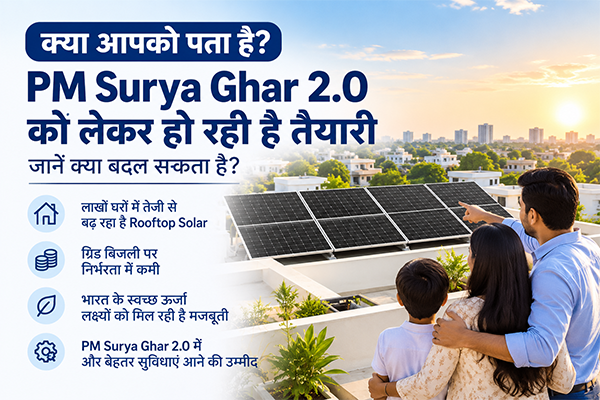
Role of PM Surya Ghar Has Already Changed the Solar Landscape
The PM Surya Ghar scheme was launched in February 2024 with an overall outlay of ₹75,021 crore and a target of supporting rooftop solar installations for one crore households. As per the existing framework, eligible residential consumers can receive Central Financial Assistance for rooftop solar systems.
The response to the scheme is noteworthy. By August 2026, more than 50 lakh households had adopted rooftop solar, commissioning around 14.8 GW of capacity. This growth proves that rooftop solar helps Indian families manage electricity costs and support a cleaner, greener energy future.
So, What Could PM Surya Ghar 2.0 Bring?
The formal notice of the new scheme, “PM Surya Ghar 2.0” is not official yet. However, the various government measures indicate the direction of the next phase. One important area can be assumed is making solar energy affordable. The government has announced higher financial assistance for the first 2 kW of rooftop solar for certain households and concessional, collateral-free loans. A current provision allows eligible borrowers to get concessional loans linked to the repo rate, which reduces the upfront financial burden of installation.
The Utility-Led Aggregation (ULA) model can make rooftop solar easier for households. The government is also focusing on battery storage, solar monitoring, and maintenance. New rooftop models, vendor ratings, and training can make solar energy more accessible and reliable.
Should You Wait for PM Surya Ghar 2.0?
This is an important question for every homeowner considering solar.
With the possibility of PM Surya Ghar 2.0, it is important to follow official updates rather than relying on rumours or unofficial announcements.
Before going solar, you can check the available subsidies, financing options, electricity needs, and local rules.
Better solar panels, efficient inverters, smart monitoring systems, and storage solutions make rooftop solar easier and more practical for homeowners.
A Greener Future Starts at Home
The next phase of India’s rooftop solar journey could focus not only on installing more systems, but also on making solar more affordable, accessible, reliable and easier to maintain.
For homeowners, this is an encouraging development. Whether PM Surya Ghar 2.0 brings new incentives, financing options, storage support or improved implementation, the larger goal remains the same: help more Indian families generate clean electricity from their own rooftops.
As a solar manufacturer, we believe every rooftop that generates clean energy is a step towards a greener and more energy-independent India.